Monday, 30 October 2017

How Nuclear Reactor Works "copied "

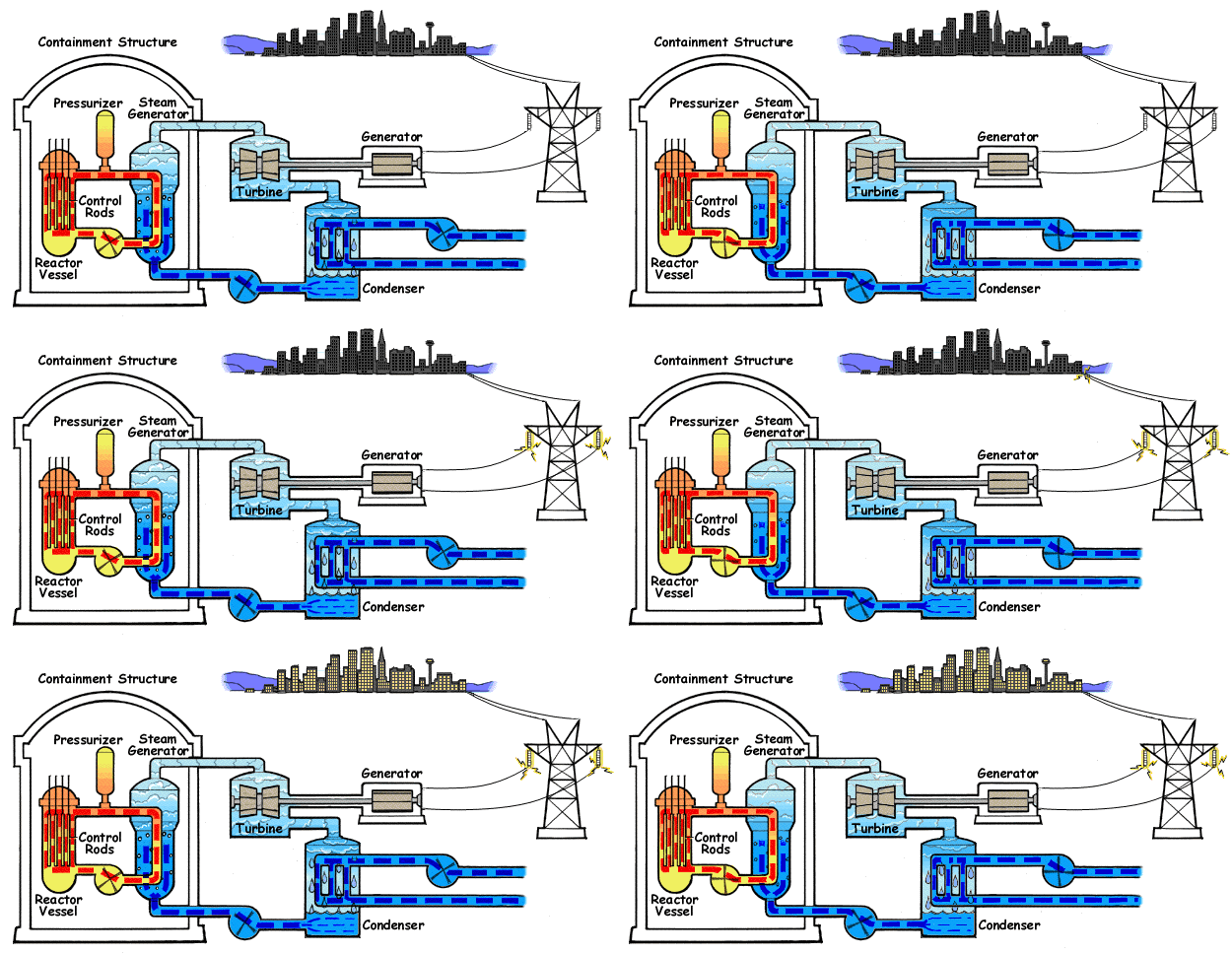
A nuclear reactor is a system that contains and controls sustained nuclear chain reactions. Reactors are used for generating electricity, moving aircraft carriers and submarines, producing medical isotopes for imaging and cancer treatment, and for conducting research.
Fuel, made up of heavy atoms that split when they absorb neutrons, is placed into the reactor vessel (basically a large tank) along with a small neutron source. The neutrons start a chain reaction where each atom that splits releases more neutrons that cause other atoms to split. Each time an atom splits, it releases large amounts of energy in the form of heat. The heat is carried out of the reactor by coolant, which is most commonly just plain water. The coolant heats up and goes off to a turbine to spin a generator or drive shaft. Nuclear reactors are just exotic heat sources.

Main components

  • The core of the reactor contains all of the nuclear fuel and generates all of the heat. It contains low-enriched uranium (<5% U-235), control systems, and structural materials. The core can contain hundreds of thousands of individual fuel pins.
  • The coolant is the material that passes through the core, transferring the heat from the fuel to a turbine. It could be water, heavy-water, liquid sodium, helium, or something else. In the US fleet of power reactors, water is the standard.
  • The turbine transfers the heat from the coolant to electricity, just like in a fossil-fuel plant.
  • The containment is the structure that separates the reactor from the environment. These are usually dome-shaped, made of high-density, steel-reinforced concrete. Chernobyl did not have a containment to speak of.
  • Cooling towers are needed by some plants to dump the excess heat that cannot be converted to energy due to the laws of thermodynamics. These are the hyperbolic icons of nuclear energy. They emit only clean water vapor.A nice animation of a nuclear reactor from the NRC.

Wednesday, 25 October 2017

Nuclear Reactor - Understanding how it works | Physics Elearnin


One of my students in grade 3 (level 12) asked me this question: "How does Nuclear reactor work ?" Thus ,as I need to know it myself I have seen that video and shared it . I hope it is the answer 

Saturday, 21 October 2017

Short story = "I Never Forget A face " > a very remarkable short story

I'LL tell you a strange thing about me - I never forget a face. The only trouble is that usually I'm quite unable to tell you the name of the person. I know what you're going to say - you suffer from the same thing yourself. Lots of people do, to some extent. But I'm not like that. When I say I never forget a face, I mean it. I can pass a fellow in the street one day and recognize him again months after, though we've never spoken to each other. My wife says sometimes that I ought to be a reporter for the newspapers and wait about at first nights at cinemas, looking for all the famous people who go to see the films. But, as I tell her, I should not be able to do very well at that. I should see the famous man or woman, but I should not be able to say which one it was. That's my trouble, as I say - names.
Of course, this trouble with names has put me in difficulties from time to time. But with a little skill one can usually get out of the difficulty in one way or another. In my work, moving round the City doing bits of business, I have to be very clever not to let a man see that I can't remember whether his name is Smith or Moses. I've annoyed people in that way and lost good business more than once. But on the whole, I think I gain more than I lose by this strange memory of mine.
    Quite often I've approached a man who didn't know me at all. I've said: "I think we've met before," and I've been able to give him some idea of where it was. I can always connect a face with a place, you see. Well, as I was saying, I can approach this fellow and remind him of a big dinner or a football match or whatever it is that his face reminds me of, and probably within five minutes we're talking about business. I can usually find out his name later on. My memory for faces helps me a lot in business.
      You can guess that there's not a man, woman or child here in Bardfield that I don't know by sight. I've lived in Bardfield ever
since the Second World War. I like the place; although it's only forty minutes from London, there's a lot of country here, village is almost a mile from the station, and that's rather troublesome. But quite a pleasant crowd of men travel up an down to the City most days, and 1 needn't tell you that I know the names of half of them, though we speak to each other cheerfully enough. My wife complains that 1 don't know the names of our neighbours in the next house, and that's true.
    Well, on this particular evening I'd been kept a bit late at the office, and it was difficult to get to the station in time to catch the train. There was quite a crowd on the train at first, but the gradually got out; and by the time we reached Ellingham - that's two stations before mine - there were only two of us left in the carriage. The other fellow wasn't one of the regular travellers but I knew he was a Bardfield man. I knew it as soon as I saw him of course. I'd smiled at him when I saw him get into the carriage
in London, and he had smiled back. But that didn't tell me his name.
      The annoying thing was that 1 couldn't remember where I knew this fellow's face from, if you understand what I mean. His face told me clearly that he was connected with Bardfield, but that was all it told me. 1 could not think where in Bardfield I had seen it. 1 guessed he must be one of those fellows who've come to live lately in the small houses by the bus-stop, but I couldn't be sure. Some of us who've lived in the place for a long time are rather unfriendly towards newcomers, but that's not my way - never has been. 1 never know where the next bit of business is going to come from, and it may come from one of them. I can't afford to neglect chances.
So when the two of us found ourselves alone in the carriage, with room to stretch our legs and be a bit comfortable, I started to talk, just as if we were old friends. But I can't say that I got much information out of him. He spoke well, with a quiet friendly manner, but he told me very little. 1 can generally find out what a man's work is in ten and a half minutes - that's the time it takes from Ellingham to Bardfield by train - but I failed this time. He looked a bit tired, I remember, as if he'd been working too hard lately, and I thought maybe that made him unwilling to talk much.
"Do you generally travel down on this train?" I asked him. That's usually a safe opening to a conversation, because either they do travel or they don't, and nine times out of ten they'll tell you why, and what hours they work, and what their work is. It's only human nature. But he just smiled and shook his head and said, "Not generally," which wasn't much help.
     Of course, I went on to talk about the train service in general, comparing this train with that, hut still he said nothing. He just
agreed with all I said, but he didn't seem to have any opinions ( his own. I told him I sometimes went up to the City by road, bit that didn't make him talk either. I didn't think it would, because you don't expect a fellow who lives in a cheap house to own a car.
Well, in the end, I had to give up. I'd told him a lot about myself! of course, so as to make things pleasant. I'd even boasted a little) about a rather nice bit of business I'd done that morning. I'\ always found that there's nothing as good as boasting to start! fellow talking. It makes him want to boast too. He seemed interested in a quiet sort of way, but it was no good. So I stopped talking and started to read my paper. And the next time I looked at him, he'd put his head back and gone off to sleep!
      We were just coming into the station then, and though the train) stopped rather suddenly, it didn't seem to wake him. Well, I'm a kind-hearted fellow and I wasn't going to let a Bardfield man be( carried on all the way to the next stop if I could help it. So I touched him sharply on the knee.
"Wake up, old fellow! We're there!" I said. He awoke at once and smiled at me. "Oh, so we are!" he said, and got out after me.
You know what the weather was like just then. When we came out of the station together it was quite dark and raining heavily. There was a wind blowing strong enough to knock you over, and it was bitterly cold. Well, what would you have done? The same as I did. I turned round and said to him:" Listen. There isn't a bus for a quarter of an hour. I've got my car in the station-yard, and if you're in one of those small houses I can take you there. It's on my way."
"Thanks very much," he said, and we walked through the water to where my old car was standing and off we went.
"This is very kind of you," he said as we started, and that was the last thing he said until we were halfway across the open country.
Then he suddenly turned round and said, "You can let me get out here."
"What, here?" I asked him. It seemed mad, because there wasn't a house within five hundred yards and, as I say, it was raining and blowing like the end of the world. But I slowed down, as anyone would.
The next thing that happened was that something hit me really hard on the back of the head. I fell forwards then everything went black. I can remember being pulled out of the and when I came to my senses aga was lying in the ditch with the rain pouring down on me with a bad headache, no car in sight and my pockets – as I found   out later - empty.
I pulled myself up at last and somehow managed to walk into Bardfield. I went straight to the police station, of course. It's the first building you reach if you come that way. And there I reported that someone had stolen my car, a new umbrella, a gold watch  and a hundred and fifty-two pounds ten shillings in notes.
   Of course, as soon as I got there I remembered who the man was; His picture was on the wall outside. I'd seen it every day for week. That's why his face reminded me of Bardfield. Under picture were some words: "Wanted for Robbery with Violence and Attempted Murder. John ———" Oh dear, I've forgotten the name again. I just can't keep names in my head. But that's the man. I tell you - I never forget a face.

Questions:
Answer the following questions : -1- What did the writer guess the traveller was ?2- How did the writer start a conversation with the stranger ?3- Why did the writer boast about a business he had done that morning ?4- How was the weather when the writer and the stranger got out of the station ?5- What did the writer do when the writer slowed down the car?


since and for


-  يأتي بعد since  نقطة زمنية تحدد بداية الحدث أما  for  يأتي بعدها مدة هذا الحدث.


ساعة12 o’clock            

a moment


شهر                   October
يوم                        Friday
فصلsummer                


two seconds / three minutes
 four hours / five days
six nights / seven weeks
Since
تاريخ              7thAugust
For
eight months/ one season

سنة2014                       

nine years

جملة ماضي بسيطI arrived  

ages

 ذلك الحين  yesterday /then

a long time

last ……………...

the last …………..

Sunday, 24 September 2017

The Story of An Hour ( the ever green text by: Kate Chopin )

The Story of An Hour
Knowing that Mrs. Mallard was afflicted with a heart trouble, great care was taken to break to her as gently as possible the news of her husband's death.
It was her sister Josephine who told her, in broken sentences; veiled hints that revealed in half concealing. Her husband's friend Richards was there, too, near her. It was he who had been in the newspaper office when intelligence of the railroad disaster was received, with Brently Mallard's name leading the list of "killed." He had only taken the time to assure himself of its truth by a second telegram, and had hastened to forestall any less careful, less tender friend in bearing the sad message.
She did not hear the story as many women have heard the same, with a paralyzed inability to accept its significance. She wept at once, with sudden, wild abandonment, in her sister's arms. When the storm of grief had spent itself she went away to her room alone. She would have no one follow her.
There stood, facing the open window, a comfortable, roomy armchair. Into this she sank, pressed down by a physical exhaustion that haunted her body and seemed to reach into her soul.
She could see in the open square before her house the tops of trees that were all aquiver with the new spring life. The delicious breath of rain was in the air. In the street below a peddler was crying his wares. The notes of a distant song which someone was singing reached her faintly, and countless sparrows were twittering in the eaves.
There were patches of blue sky showing here and there through the clouds that had met and piled one above the other in the west facing her window.
She sat with her head thrown back upon the cushion of the chair, quite motionless, except when a sob came up into her throat and shook her, as a child who has cried itself to sleep continues to sob in its dreams.
She was young, with a fair, calm face, whose lines bespoke repression and even a certain strength. But now there was a dull stare in her eyes, whose gaze was fixed away off yonder on one of those patches of blue sky. It was not a glance of reflection, but rather indicated a suspension of intelligent thought.
There was something coming to her and she was waiting for it, fearfully. What was it? She did not know; it was too subtle and elusive to name. But she felt it, creeping out of the sky, reaching toward her through the sounds, the scents, the color that filled the air.
Now her bosom rose and fell tumultuously. She was beginning to recognize this thing that was approaching to possess her, and she was striving to beat it back with her will--as powerless as her two white slender hands would have been. When she abandoned herself a little whispered word escaped her slightly parted lips. She said it over and over under the breath: "free, free, free!" The vacant stare and the look of terror that had followed it went from her eyes. They stayed keen and bright. Her pulses beat fast, and the coursing blood warmed and relaxed every inch of her body.
She did not stop to ask if it were or were not a monstrous joy that held her. A clear and exalted perception enabled her to dismiss the suggestion as trivial. She knew that she would weep again when she saw the kind, tender hands folded in death; the face that had never looked save with love upon her, fixed and gray and dead. But she saw beyond that bitter moment a long procession of years to come that would belong to her absolutely. And she opened and spread her arms out to them in welcome.
There would be no one to live for during those coming years; she would live for herself. There would be no powerful will bending hers in that blind persistence with which men and women believe they have a right to impose a private will upon a fellow-creature. A kind intention or a cruel intention made the act seem no less a crime as she looked upon it in that brief moment of illumination.
And yet she had loved him--sometimes. Often she had not. What did it matter! What could love, the unsolved mystery, count for in the face of this possession of self-assertion which she suddenly recognized as the strongest impulse of her being!
"Free! Body and soul free!" she kept whispering.
Josephine was kneeling before the closed door with her lips to the keyhole, imploring for admission. "Louise, open the door! I beg; open the door--you will make yourself ill. What are you doing, Louise? For heaven's sake open the door."
"Go away. I am not making myself ill." No; she was drinking in a very elixir of life through that open window.
Her fancy was running riot along those days ahead of her. Spring days, and summer days, and all sorts of days that would be her own. She breathed a quick prayer that life might be long. It was only yesterday she had thought with a shudder that life might be long.
She arose at length and opened the door to her sister's importunities. There was a feverish triumph in her eyes, and she carried herself unwittingly like a goddess of Victory. She clasped her sister's waist, and together they descended the stairs. Richards stood waiting for them at the bottom.
Someone was opening the front door with a latch key. It was Brently Mallard who entered, a little travel-stained, composedly carrying his grip-sack and umbrella. He had been far from the scene of the accident, and did not even know there had been one. He stood amazed at Josephine's piercing cry; at Richards' quick motion to screen him from the view of his wife.
When the doctors came they said she had died of heart disease--of the joy that kills.


Thursday, 7 September 2017

Critical Essays Philosophical and Political Background of Gulliver's Travels - "copied"

Critical Essays Philosophical and Political Background of Gulliver's Travels

Swift has at least two aims in Gulliver's Travels besides merely telling a good adventure story. Behind the disguise of his narrative, he is satirizing the pettiness of human nature in general and attacking the Whigs in particular. By emphasizing the six-inch height of the Lilliputians, he graphically diminishes the stature of politicians and indeed the stature of all human nature. And in using the fire in the Queen's chambers, the rope dancers, the bill of particulars drawn against Gulliver, and the inventory of Gulliver's pockets, he presents a series of allusions that were identifiable to his contemporaries as critical of Whig politics.
Why, one might ask, did Swift have such a consuming contempt for the Whigs? This hatred began when Swift entered politics as the representative of the Irish church. Representing the Irish bishops, Swift tried to get Queen Anne and the Whigs to grant some financial aid to the Irish church. They refused, and Swift turned against them even though he had considered them his friends and had helped them while he worked for Sir William Temple. Swift turned to the Tories for political allegiance and devoted his propaganda talents to their services. Using certain political events of 1714-18, he described in Gulliver's Travels many things that would remind his readers that Lilliputian folly was also English folly — and, particularly, Whig folly. The method, for example, which Gulliver must use to swear his allegiance to the Lilliputian emperor parallels the absurd difficulty that the Whigs created concerning the credentials of the Tory ambassadors who signed the Treaty of Utrecht.
Swift's craftiness was successful. His book was popular because it was a compelling adventure tale and also a puzzle. His readers were eager to identify the various characters and discuss their discoveries, and, as a result, many of them saw politics and politicians from a new perspective.
Within the broad scheme of Gulliver's Travels, Gulliver seems to be an average man in eighteenth-century England. He is concerned with family and with his job, yet he is confronted by the pigmies that politics and political theorizing make of people. Gulliver is utterly incapable of the stupidity of the Lilliputian politicians, and, therefore, he and the Lilliputians are ever-present contrasts for us. We are always aware of the difference between the imperfect (but normal) moral life of Gulliver, and the petty and stupid political life of emperors, prime ministers, and informers.
In the second book of the Travels, Swift reverses the size relationship that he used in Book I. In Lilliput, Gulliver was a giant; in Brobdingnag, Gulliver is a midget. Swift uses this difference to express a difference in morality. Gulliver was an ordinary man compared to the amoral political midgets in Lilliput. Now, Gulliver remains an ordinary man, but the Brobdingnagians are moral men. They are not perfect, but they are consistently moral. Only children and the deformed are intentionally evil.
Set against a moral background, Gulliver's "ordinariness" exposes many of its faults. Gulliver is revealed to be a very proud man and one who accepts the madness and malice of European politics, parties, and society as natural. What's more, he even lies to conceal what is despicable about them. The Brobdingnagian king, however, is not fooled by Gulliver. The English, he says, are "odious vermin."
Swift praises the Brobdingnagians, but he does not intend for us to think that they are perfect humans. They are superhumans, bound to us by flesh and blood, just bigger morally than we are. Their virtues are not impossible for us to attain, but because it takes so much maturing to reach the stature of a moral giant, few humans achieve it.
Brobdingnag is a practical, moral utopia. Among the Brobdingnagians, there is goodwill and calm virtue. Their laws encourage charity. Yet they are, underneath, just men who labor under every disadvantage to which man is heir. They are physically ugly when magnified, but they are morally beautiful. We cannot reject them simply because Gulliver describes them as physically gross. If we reject them, we become even more conscious of an ordinary person's verminous morality.
In Books I and II, Swift directs his satire more toward individual targets than firing broadside at abstract concepts. In Book I, he is primarily concerned with Whig politics and politicians rather than with the abstract politician; in Book II, he elects to reprove immoral Englishmen rather than abstract immorality. In Book III, Swift's target is somewhat abstract — pride in reason — but he also singles out and censures a group of his contemporaries whom he believed to be particularly depraved in their exaltation of reason. He attacks his old enemies, the Moderns, and their satellites, the Deists and rationalists. In opposition to their credos, Swift believed that people were capable of reasoning, but that they were far from being fully rational. For the record, it should probably be mentioned that Swift was not alone in denouncing this clique of people. The objects of Swift's indignation had also aroused the rage of Pope, Arbuthnot, Dryden, and most of the orthodox theologians of the Augustan Age.
This love of reason that Swift criticizes derived from the rationalism of the seventeenth and eighteenth centuries. John Locke's theories of natural religion were popularly read, as were Descartes' theories about the use of reason. Then a loosely connected group summarized these opinions, plus others, and a cult was born: They called themselves the Deists.
In general, the Deists believed that people could reason, observe the universe accurately, and perceive axioms intuitively. With these faculties, people could then arrive at religious truth; they did not need biblical revelation. Orthodox theology has always made reason dependent on God and morality, but the Deists refuted this notion. They attacked revealed religion, saying that if reason can support the God described by the Bible, it may also conclude that God is quite different from the biblical God. The answer depends upon which observations and axioms the reasoner chooses to use.
Even before he wrote the Travels, Swift opposed excessive pride in reason. In his ironical Argument Against Abolishing Christianity, he makes plain what he considers to be the consequences of depending on reason, rather than upon faith and revelation. Disbelief, he said, is the consequence of presumptuous pride in reasoning, and immorality is the consequence of disbelief. Swift believed that religion holds moral society together. A person who does not believe in God by faith and revelation is in danger of disbelieving in morality.
To Swift, rationalism leads to Deism, Deism to atheism, and atheism to immorality. Where people worship reason, they abandon tradition and common sense. Both tradition and common sense tell humankind that murder, whoring, and drunkenness, for example, are immoral. Yet, if one depends on reason for morality, that person can find no proof that one should not drink, whore, or murder. Thus, reasonably, is one not free to do these things? Swift believed that will, rather than reason, was far too often the master.
Alexander Pope agreed with the position that Swift took. In his Essay on Man, he states that people cannot perceive accurately. Our axioms are usually contradictory, and our rational systems of living in a society are meaninglessly abstract. People, he insists, are thoroughly filled with self-love and pride; they are incapable of being rational — that is, objective. Swift would certainly concur.
In Book III, Laputan systematizing is exaggerated, but Swift's point is clear and concrete: Such systematizing is a manifestation of proud rationalism. The Laputans think so abstractly that they have lost their hold on common sense. They are so absorbed in their abstractions that they serve food in geometric and musical shapes. Everything is relegated to abstract thought, and the result is mass delusion and chaos. The Laputans do not produce anything useful; their clothes do not fit, and their houses are not constructed correctly. These people think — but only for abstract thinking's sake; they do not consider ends.
In a similar fashion, Swift shows that philology and scholarship betray the best interests of the Luggnaggians; pragmatic scientism fails in Balnibarbi; and accumulated experience does not make the Struldbruggs either happy or wise. In his topical political references, Swift demonstrates the viciousness and cruelty, as well as the folly, that arise from abstract political theory imposed by selfish politicians. The common people, Swift says, suffer. He also cites the folly of Laputan theorists and the Laputan king by referring to the immediate political blunders of the Georges.
The Travels is structured very much like a variation on the question, "Why are people so often vicious and cruel?" and the answer, "Because they succumb to the worst elements in themselves." Man is an infinitely complex animal; he is many, many mixtures of intellect and reason, charity and emotion. Yet reason and intellect are not synonymous — even if they might profitably be; nor are emotion and charity necessarily akin to one another. But few people see Man as the grey mixture of varying qualities that he is. Man oversimplifies, and, in the last book of the Travels, Swift shows us the folly of people who advance such theories. In his time, it was a popular notion that a Reasonable Man was a Complete Man. Here, Swift shows us Reason exalted. We must judge whether it is possible or desirable for Man.
The Houyhnhnms are super-reasonable. They have all the virtues that the stoics and Deists advocated. They speak clearly, they act justly, and they have simple laws. They do not quarrel or argue since each knows what is true and right. They do not suffer from the uncertainties of reasoning that afflict Man. But they are so reasonable that they have no emotions. They are untroubled by greed, politics, or lust. They act from undifferentiated benevolence. They would never prefer the welfare of one of their own children to the welfare of another Houyhnhnm simply on the basis of kinship.
Very simply, the Houyhnhnms are horses; they are not humans. And this physical difference parallels the abstract difference. They are fully rational, innocent, and undepraved. Man is capable of reason, but never wholly or continuously, and he is — but never wholly or continuously — passionate, proud, and depraved.
In contrast to the Houyhnhnms, Swift presents their precise opposite: the Yahoos, creatures who exhibit the essence of sensual human sinfulness. The Yahoos are not merely animals; they are animals who are naturally vicious. Swift describes them in deliberately filthy and disgusting terms, often using metaphors drawn from dung. The Yahoos plainly represent Mankind depraved. Swift, in fact, describes the Yahoos in such disgusting terms that early critics assumed that he hated Man to the point of madness. Swift, however, takes his descriptions from the sermons and theological tracts of his predecessors and contemporaries. If Swift hated Man, one would also have to say that St. Francis and St. Augustine did, too. Swift's descriptions of depraved Man are, if anything, milder than they might be. One sermon writer described Man as a saccus stercorum, a sack filled with dung. The descriptions of the Yahoos do not document Swift's supposed misanthropy. Rather, the creatures exhibit physically the moral flaws and natural depravity that theologians say plague the offspring of Adam.
Midway between the poles of the Houyhnhnms and the Yahoos, Swift places Gulliver. Gulliver is an average man, except that he has become irrational in his regard for reason. Gulliver is so disgusted with the Yahoos and so admires the Houyhnhnms that he tries to become a horse.
This aspiration to become a horse exposes Gulliver's grave weakness. Gullible and proud, he becomes such a devotee of reason that he cannot accept his fellow humans who are less than totally reasonable. He cannot recognize virtue and charity when they exist. Captain Pedro de Mendez rescues Gulliver and takes him back to Europe, but Gulliver despises him because Mendez doesn't look like a horse. Likewise, when he reaches home, Gulliver hates his family because they look and smell like Yahoos. He is still capable of seeing objects and surfaces accurately, but he is incapable of grasping true depths of meaning.
Swift discriminates between people as they are idealized, people as they are damned, people as they possibly could be, and others as they are. The Houyhnhnms embody the ideal of the rationalists and stoics; the Yahoos illustrate the damning abstraction of sinful and depraved Man; and Pedro de Mendez represents virtue possible to Man. Gulliver, usually quite sane, is misled when we leave him, but he is like most people. Even dullards, occasionally, become obsessed by something or other for a while before lapsing back into their quiet, workaday selves. Eventually, we can imagine that Gulliver will recover and be his former unexciting, gullible self.
Swift uses the technique of making abstractions concrete to show us that super-reasonable horses are impossible and useless models for humans. They have never fallen and therefore have never been redeemed. They are incapable of the Christian virtues that unite passion and reason: Neither they nor the Yahoos are touched by grace or charity. In contrast, the Christian virtues of Pedro de Mendez and the Brobdingnagians (the "least corrupted" of mankind) are possible to humans. These virtues are the result of grace and redemption. Swift does not press this theological point, however. He is, after all, writing a satire, not a religious tract.
Tuesday, 22 August 2017

Vacation

As it was  a long and tiring school year , i was longing waiting for such a vacation to have some rest. All I did ,was to eat and rest  so, it finished so quickly!!!!
 .but i can just remember clearly the day  I arrived and the day I left .....LOL , some good and delicious meals and finally dreams- during much sleep -that I
'm in a vacation 

Saturday, 8 July 2017

How to make a writing test

Test writing  
-        The elements of a good test
-       Validity of a test
-       Reliability of a test
-       The affect of tests
-       Assessing difficulty
-       Conclusion
If you think taking tests is difficult then you should try writing them! Writing a good test is indeed quite a challenge and one that takes patience, experience and a degree of trial and error. There are many steps you can take to ensure that your test is more effective and that test writing becomes a learning experience.
The elements of a good test
A good test will give us a more reliable indication of our students' skills and it ensures that they don't suffer unfairly because of a poor question. How can we be sure that we have produced a good test?
·         One way is very simply to think about how we feel about it afterwards. Do the results reflect what we had previously thought about the skills of the students? Another simple way is to ask the students for some feedback. They will soon tell you if they felt a question was unfair or if a task type was unfamiliar.
Validity of a test
A good test also needs to be valid. It must test what it is meant to test. A listening test that has very complicated questions afterwards can be as much of a test of reading as listening. Also a test that relies on cultural knowledge cannot measure a student's ability to read and comprehend a passage.
Reliability of a test
A test should also be reliable. This means that it should produce consistent results at different times. If the test conditions stay the same, different groups of students at a particular level of ability should get the same result each time.
·         A writing test may not be reliable as the marking may be inconsistent and extremely subjective, especially if there are a number of different markers. Thus to try and ensure the test is more reliable it is essential to have clear descriptors of what constitutes each grade.
·         In an oral interview it is important to ensure that the examiner maintains the same attitude with all the candidates. The test will be less reliable if he is friendly with some candidates but stern with others. You should try to ensure that the test conditions are as consistent as possible.
The affect of tests
We must also bear in mind the affect of our tests. Has the test caused too much anxiety in the students? Are the students familiar with the test types in the exam?
·         If a student has never seen a cloze passage before she may not be able to write a test that reflects her true ability. The solution to this is to try and reduce the negative effects by using familiar test types and making the test as non-threatening as possible.
Other features of a good test
Other features of a good test are that there is a variety of test types and that it is as interesting as possible.
·         A variety of test types will ensure that the students have to stay focused and minimise the tiredness and boredom you can feel during a repetitive test.
·         Finding reading passages that are actually interesting to read can also help to maintain motivation during a test. A test should also be as objective as possible, providing a marking key and descriptors can help with this.
Assessing difficulty
Another important feature of a good test is that it is set at an appropriate level. You can only really find this out by giving the test and studying the results. Basically if everyone gets above 90% you know it is too easy or if everyone gets less than 10% it is obviously too difficult. For tests that aren't so extreme you will need to do some analysis of your test. You can do this by analyzing the individual items for difficulty.
·         In order to do this mark all of the tests and divide them into three equal groups, high, middle and low.
·         Make a note for each item of how many candidates got the answer correct from the high and the low group (leave aside the middle group). To find the level of difficulty you need to do a quick calculation.
o    Take one question and add the number of students from the high group who have the correct answer to the number from the low group.
o    Then divide this by the total number of people from both groups (high and low). It is thought that if over 90% of candidates get the answer right it is too easy. If fewer than 30% get it right it is too difficult.
·         Also bear in mind that if most of the answers are in the 30's and 40's it would be best to rewrite the test. It's the same if most of the answers are in the 80's and 90's.
·         The final step is to reject the items that are too easy or difficult.
Conclusion
Always bear in mind though that the difficulty of an item may relate to whether it has been covered in class or it may give an indication of how well it was understood. Such test analysis can give us information about how effective our teaching has been as well as actually evaluating the test. Evaluating tests carefully can ensure that the test improves after it is taken and can give us feedback on improving our test writing.
Below is a suggested procedure for writing a test.
·         Decide what kind of test it is going to be (achievement, proficiency)
·         Write a list of what the test is going to cover
·         Think about the length, layout and the format
·         Find appropriate texts
·         Weight the sections according to importance/time spent etc.
·         Write the questions
·         Write the instructions and examples
·         Decide on the marks
·         Make a key
·         Write a marking scheme for less objective questions
·         Pilot the test
·         Review and revise the test and key

·         After the test has been taken, analyze the results and decide what can be kept / rejected.
                                                                       (copied)